The Rhythm of Needle and Thread
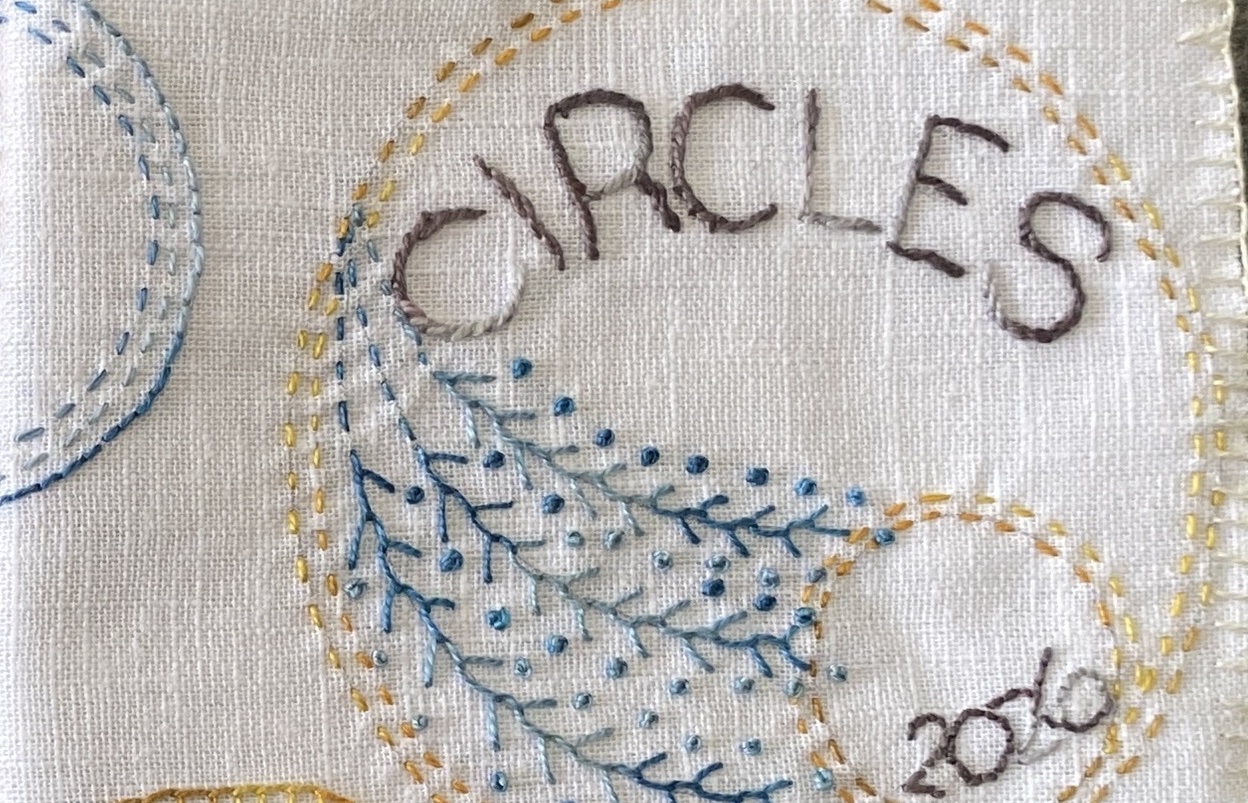
Last year I began a new textile book. I wanted to try a new-to-me way of binding, following Anne Wood, but instead it became one of those projects that demanded patience, pauses, problem-solving, and more than a little stubbornness.
There were starts and stops along the way, experiments that worked beautifully and others that definitely did not. At one point I had to redo eight pages after an unsuccessful attempt to sew the book together – you can read more about it below.
I also spent a great deal of time thinking about how the book itself should be assembled. I considered several different binding methods before finally returning to one I had used before — one I knew worked well and, most importantly, one I felt comfortable with. Even then, the process was not without challenges. A needle or two was sacrificed along the way, but with patience, a bit of effort, and a great deal of love, the book finally came together.
Now my new textile circle book is finally finished. And I did it my way (all of a sudden I can hear Frank Sinatra singing …).


Hand stitching has slowly become a nightly ritual for me – a quiet time at the end of the day that I genuinely miss when life gets too busy and I cannot stitch. There is something deeply calming about slowing down and settling into the rhythm of needle and thread passing through the linen fabric I chose as the foundation for this work. Stitch after stitch, the process becomes almost meditative.
And yet, despite the fact that I stitch almost every evening, I still somehow forget how long hand stitching truly takes. Some of the designs in this book required hours to complete. Progress happens slowly, one stitch at a time, often at the end of long days filled with many other responsibilities and activities. Little by little, night after night, the pages evolved beneath my hands.
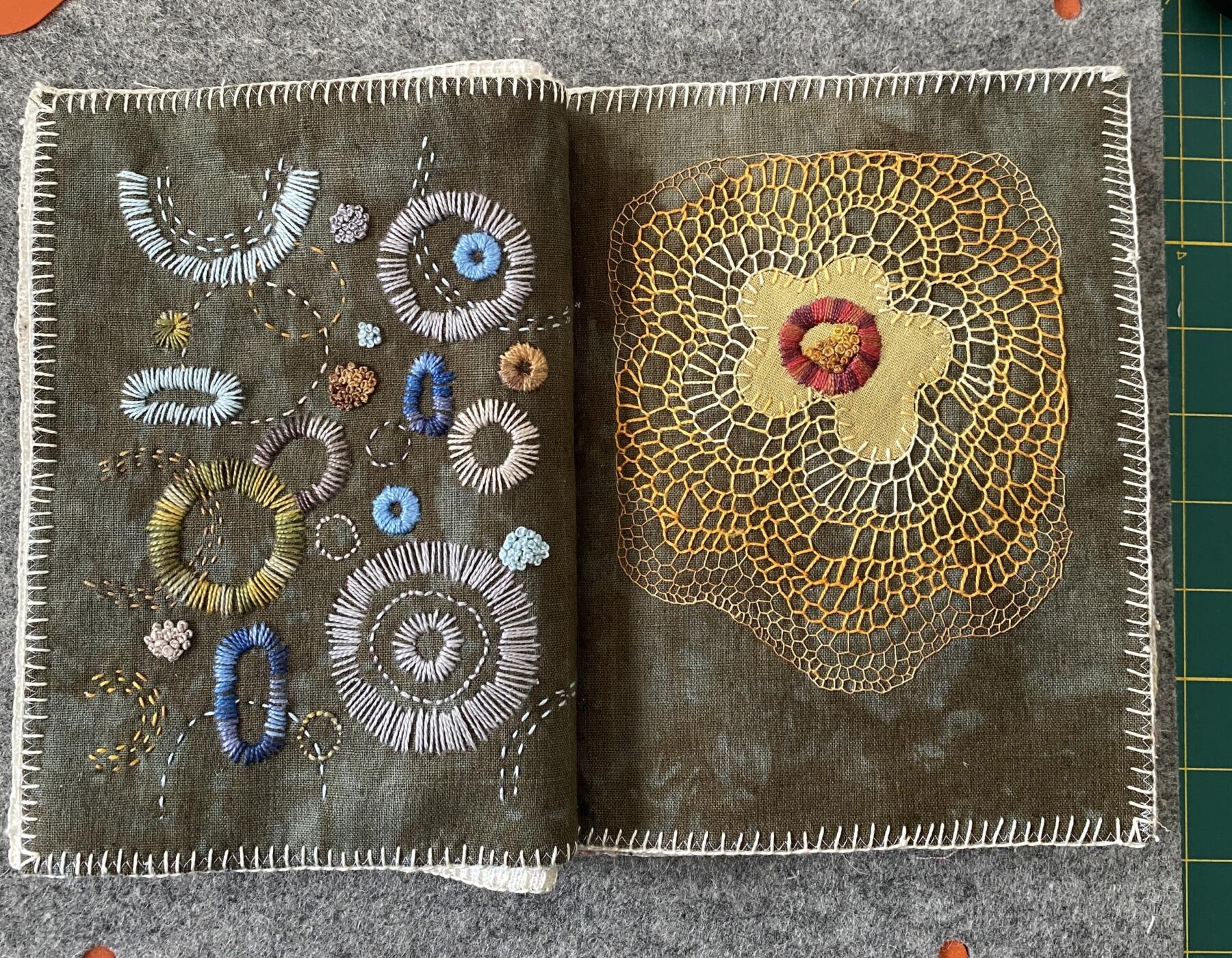
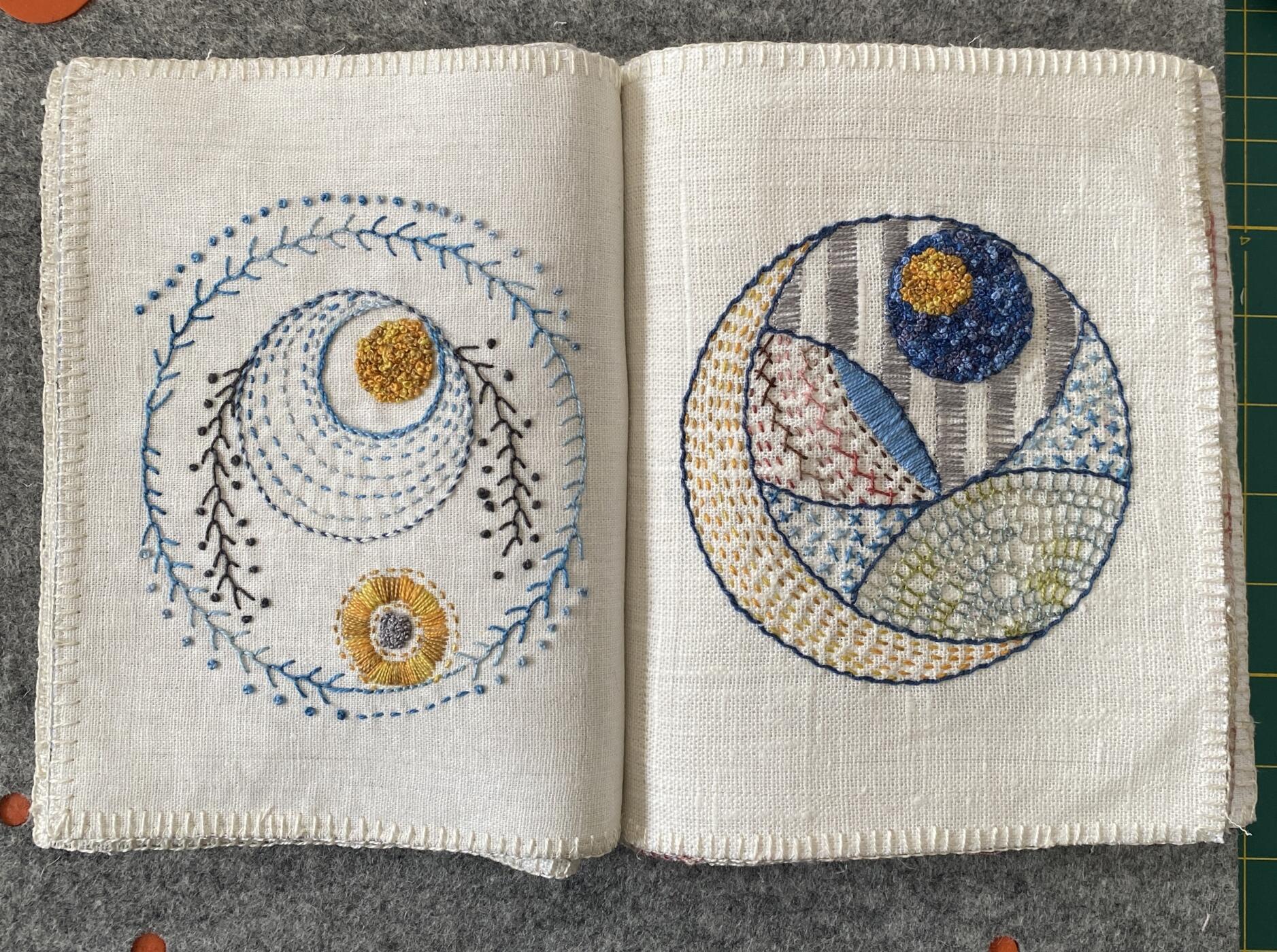
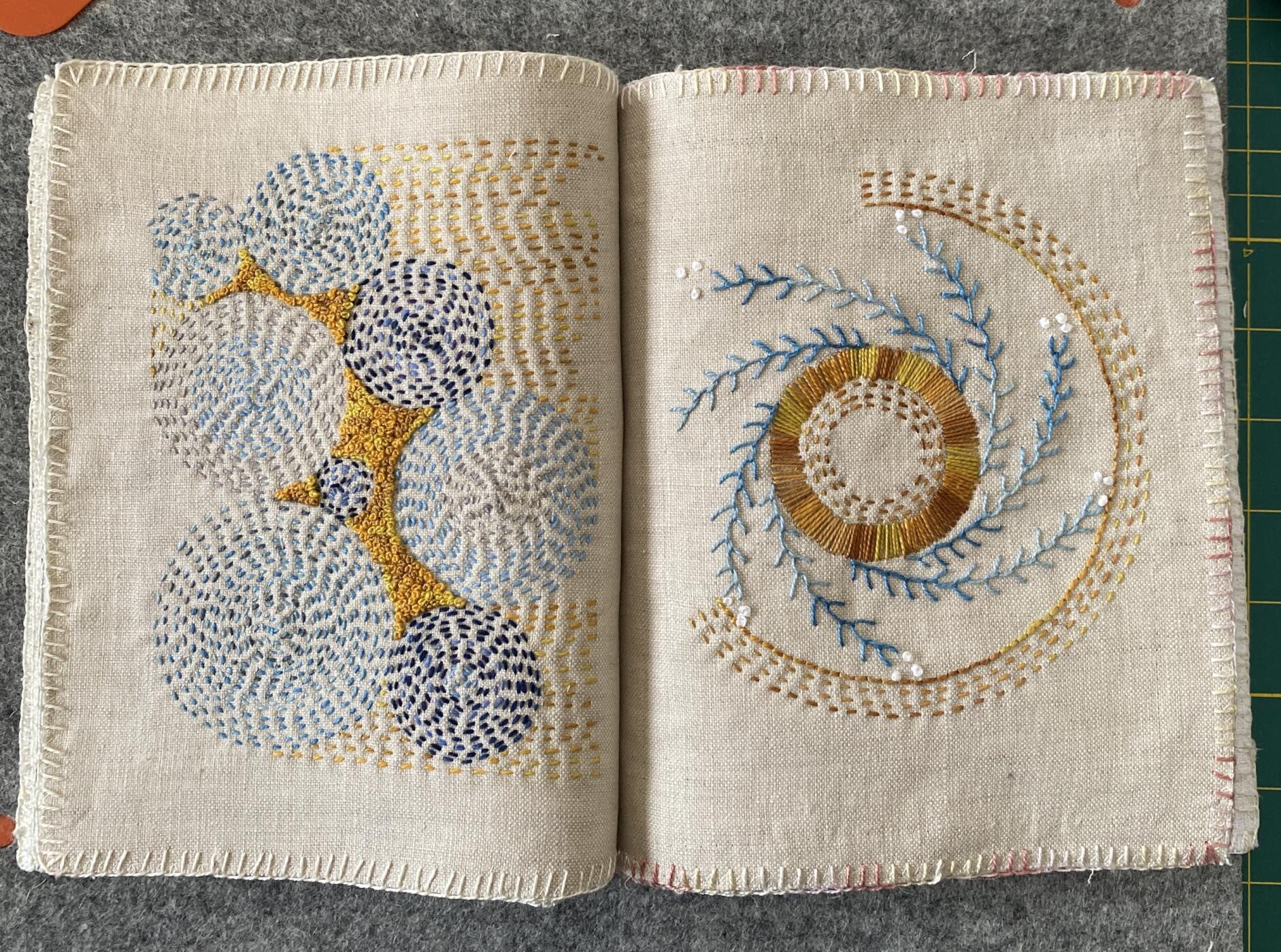
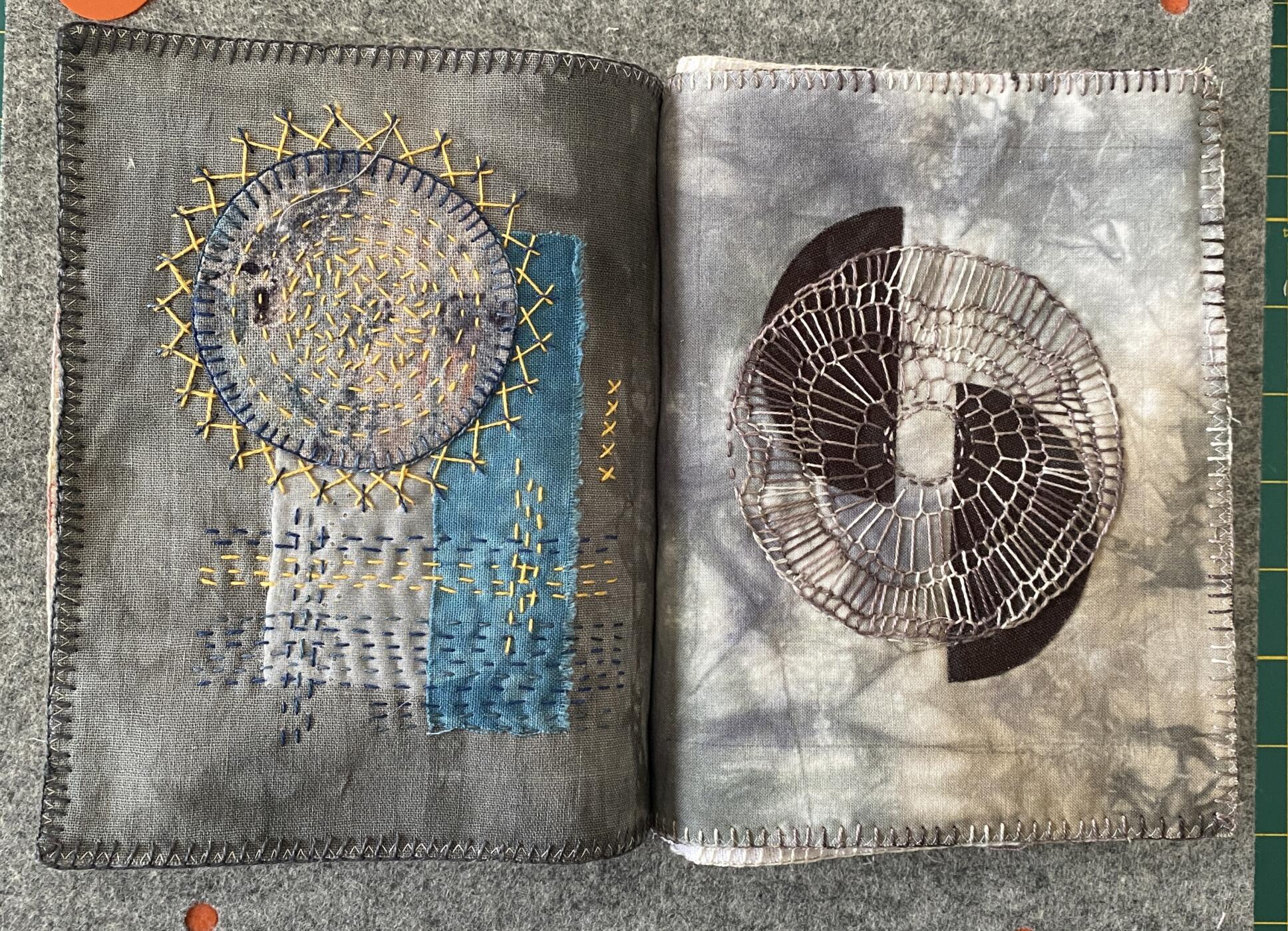
This book became an exploration of circles in many forms. I found myself returning again and again to simple hand stitches — mostly running stitch, blanket stitch, feather stitch, satin stitch, and colonial knots — discovering different ways they could suggest movement, texture, and circular forms across the pages. Some areas are densely stitched while others are quieter, allowing the texture of the linen and the simplicity of the marks to speak for themselves.
Below is a view of the page spreads – in order.
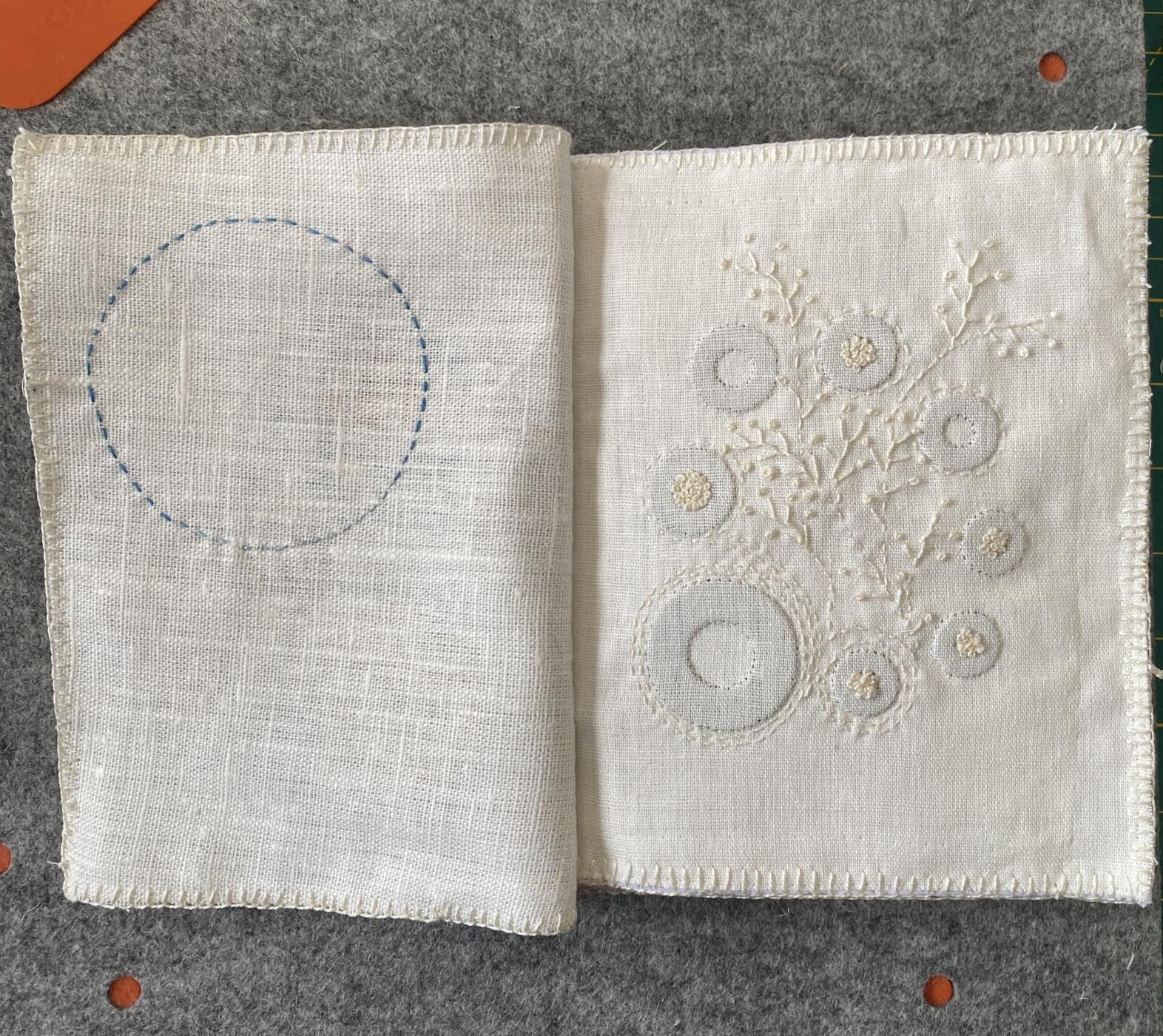



I wanted to create a cover for the book – with a sort of title – so I planned, drew and stitched. And in the end … I decided I did not like it for the cover. But, I was still able to use it as the inside of the back cover, where it belongs.

This is the back cover, that holds one of the original pages that were stitched in (for me) too small a piece of fabric. So I appliquéd it to a piece of linen and it became the back cover.
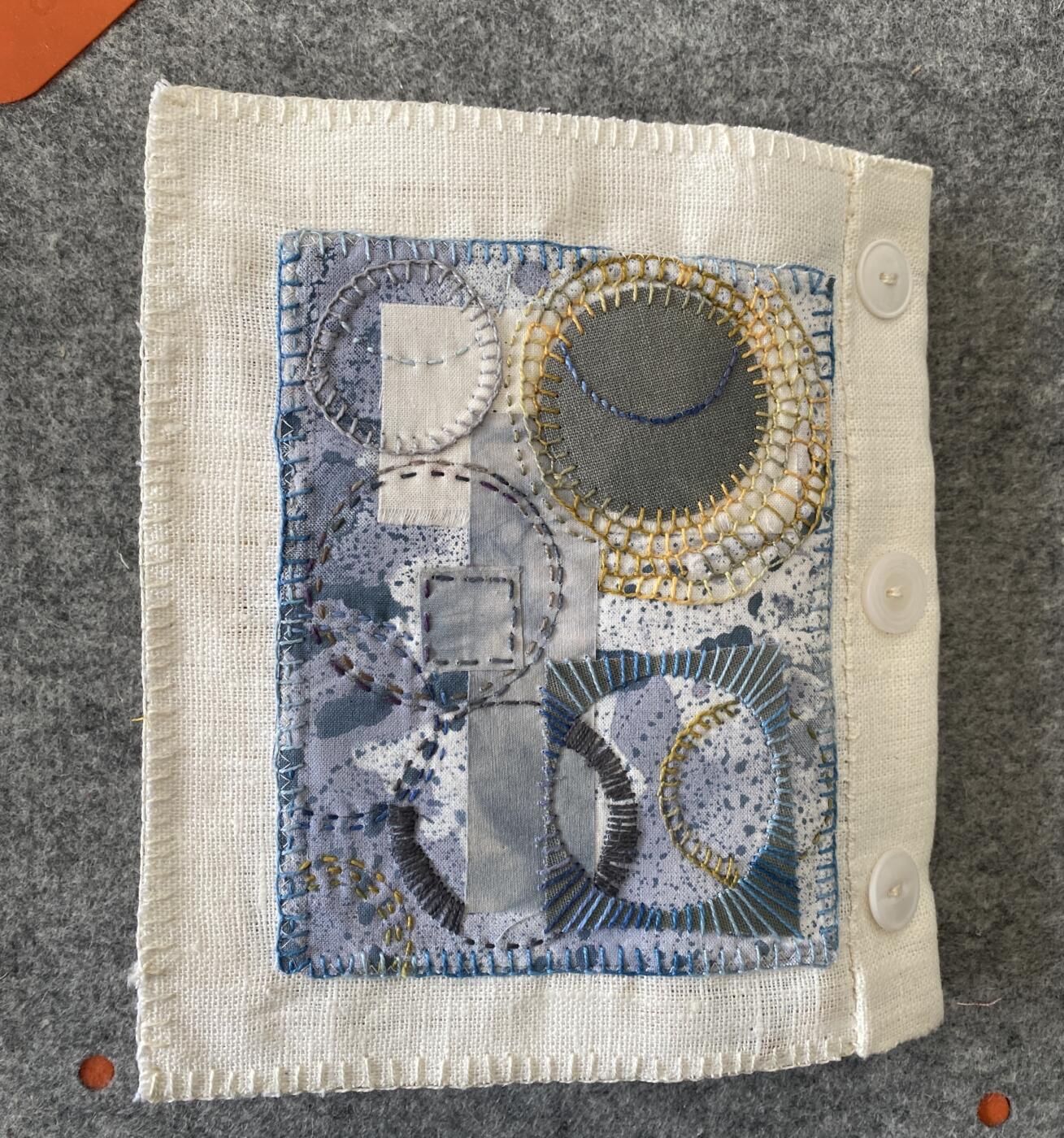
After all the trials and tribulations, this little book now holds not only fabric and thread, but also many evenings of slow stitching, problem-solving, meditation, talks with myself and quiet moments along the way. And for now, I am simply happy to finally hold it in my hands.
Thanks for reading, Until I write again,
Ana
Discover more from Ana Buzzalino
Subscribe to get the latest posts sent to your email.




Such a beautiful undertaking and what a great result! Funny, I was contemplating just last night doing a project with circles! You inspired me telepathically, perhaps!
As an aside, your presentation for Global Quilt Connection was excellent. You present so fluently! Well done.
Kathy
Thank you Kathy. Circles are something that in one way or another end up showing in my work all the time. Go for it! I’d love to see what you make. So many possibiities.
And thank you for your kind words about the presentation at Sampler Platter. So happy you liked it. Have a wonderful week,
Beautiful book! I love stitching circles, the ideas are endless. I also love making books and I’m curious how you actually bound your book together. It looks to me that you stacked your pages, wrapped the spine, and then stitched through all layers with the buttons. Is that correct, or is there more to it that we can’t see?
Thank you. I am so happy that you like it. And yes, that’s basically how I sewed and bound the book together.
Your book is absolutely beautiful and I am glad to know that there are trials and tribulations along the way even for someone is talented as you. Do you think you will make another book?
Thank you for sharing your experience and letting us glimpse your stunning stitching.
Thank you. So happy you like it. And yes, lots of trials, changing of mind, going back and forth … it’s the nature of creativity I think :)
Definitely! I am making another smaller book right now to try a different binding method. I’ve started posting some photos of the pages on Instagram. Hope you enjoy it.
And while I am stitching on that one, I’m already thinking of my next one :)
I’ve been following the progress of this lovely book on Instagram. Thank you so much for sharing your work, it is very generous of you. I’m inspired to try something similar.
Thanks so much. Glad you like it. And yes, go for it!
Absolutely love this!! Amazing work.
Thank you so much Michelle. So happy you like it.
I love circles too. Your book is lovely. I especially like the radiating spirals; 10 & 16? in the middle above one another. I like the same colour scheme of blue and brown. It feels calming to look at the whole book. I’ve just learned to appreciate how slow the ‘slow’ in ‘slow stitching’ is, after taking a beginners hand embroidery class at Quilt Canada in Winnipeg. We learned how to do a variety of flowers in a small landscape quilt. At the end of the day, all I had to show for it was a couple of stems and two tiny branches of a bush. I loved the teacher, Julie Garcia, and her samples so I am hoping to finish my little flower bed with tree. It will be a great little project to carry in my purse for those ferry rides and waiting times.
So good to see you in Winnipeg. And yes, the “slow” is “slow” but oh so satisfying. I hope you finish your little flowerbed with tree.