Building on Ideas

Last week, I shared a glimpse of the stitching I’ve been doing using vintage fabrics, lace, trim, and lots of hand stitches. I’m still exploring this gentle, satisfying pace of making—and there’s more to come soon.
This week, I’m turning my attention back to a workshop I started with Stitch Club, led by textile artist Ruth Norbury. Her work focuses on architecture, decay and old buildings – right up my alley – capturing the details of old buildings with beautiful texture and depth – so I’ve been thinking about which building I want to work with.
I have a few possibilities in mind: something with a sense of history, perhaps weathered and crumbling in places, but still full of character. Once I choose the building, the next step will be transferring the design to fabric so I can begin stitching.
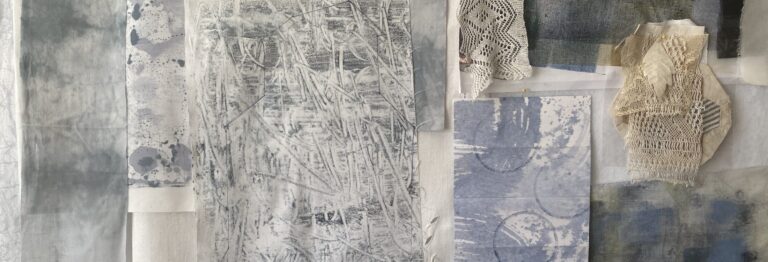
Last week, I showed you the work as it stood at the time: first, making the “fabric” with small bits and bobs of fabric and lace; then the stitching and the cutting. After that, the pieces were placed in a laundry bag and run through the washing cycle so they fray.
The next step was to reassemble the pieces into another “fabric”. And stitch everything down once again. I’ve really been enjoying working this way—slowly and intentionally. There’s something so grounding about hand stitching. The quiet rhythm of the needle going through the fabric is almost meditative for me. It gives me space to think, or not think at all, which can be just as valuable. I often find myself stitching in the evenings while watching TV or sitting with a cup of tea, and sometimes I bring it along when visiting with friends. It’s a gentle, portable kind of creativity that fits into my life in such a comforting way. I think that’s part of why I keep coming back to it—it slows me down in the best possible way.

I chose to follow her process exactly as she teaches it. That meant tracing the design onto tracing paper, stitching directly through the paper onto the fabric, and then carefully removing the paper once the stitching was complete. While I didn’t enjoy the step of picking out the tiny bits of paper (especially out of thin channels like the window frames), I felt it was important to experience the technique as Ruth intended. It gave me a better understanding of how and why it works for her. Next time, I know I’ll adjust this part of the process to fit the way I work.


This project also brought me back to my sewing machine, and I didn’t realize how much I had missed it until I turned it on. The familiar rhythmic sound of the machine was like music to my heart. There’s something so satisfying about the steady hum and the way the stitches form so precisely. I used a regular presser foot for some of the more controlled lines, and then switched to free-motion for the more expressive areas—it really was the best of both worlds. I loved the contrast between the precision and the freedom, and how each approach added something different to the piece.

And if you are wondering, yes, the threads are left long on purpose. To add texture. It makes it a bit difficult to stitch around them, but, once again, Ruth’s method. And I promised myself I’d do it her way.
I’ll keep you posted as this project develops—it’s always exciting to begin something new, especially when there’s room to let the process unfold slowly.
And if you’d like to try your hand at some slow stitching of your own, I have a few slow stitching kits available in my shop. They’re a lovely way to ease into the practice, with curated scraps, a few surprises, and all the freedom to make it your own.
Until I write again, keep stitching. Hope the weather has been nice and warm where you are.
Ana
Discover more from Ana Buzzalino
Subscribe to get the latest posts sent to your email.